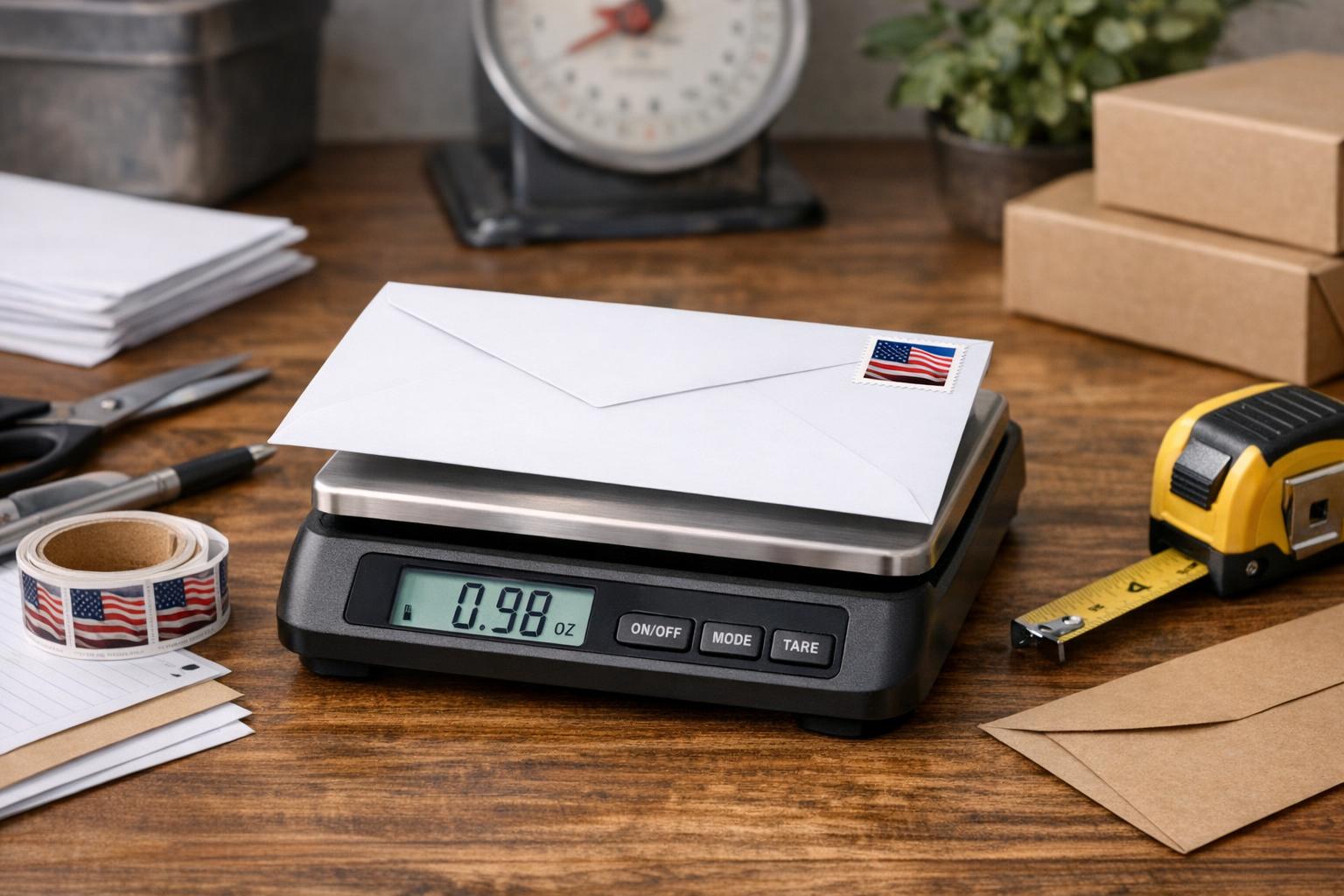
You can get accurate postage without a trip to the post office. Weighing a letter at home is straightforward once you know the right tools, a couple of tricks, and how USPS rounds ounces.
## How To Weigh A Letter At Home: Simple Methods
If you’ve ever wondered how to weigh a letter at home so you don’t overpay or get a surprise at the counter, start by picking one of three realistic methods: a postal or kitchen scale, a precise pocket/jewelry scale, or a DIY balance trick. Each works; they just differ in cost and ease.
### Choose The Right Scale
A small postal or digital kitchen scale that measures in ounces and grams is the best balance of price and accuracy. Look for one that reads to 0.1 oz or 1 g. Jewelry or pocket scales read to 0.01 g and are excellent if you send a lot of thin, light items. Analog bathroom or old mechanical kitchen scales can work, but they’re less precise and prone to repeat error.
### What You’ll Need
– A scale that measures in ounces (or grams).
– The envelope with contents sealed the way you’ll mail it.
– A flat surface and a few extra minutes to calibrate.
## Step-By-Step Weighing Process
How to weigh a letter at home without wasting time: do it in three clean steps—calibrate, tare, measure.
### Calibrate And Tare Properly
Turn the scale on, let it stabilize, and if it has a calibration function, follow the manual. Place the empty envelope on the scale first, note its weight, then remove it and zero the scale (tare) if that’s easier. If you plan to weigh multiple letters in the same envelope type, weigh one empty envelope and subtract that weight from future measures.
#### Tare Trick For Small Items
If your scale can’t handle the envelope flat, place a clean plate on it, hit tare to zero, then put the envelope on the plate. The scale will ignore the plate and show only the envelope plus contents.
### Read And Round Up
USPS charges in whole-ounce increments for First-Class Mail letters. That means if your measurement reads 1.1 oz, you pay for 2 oz. After you’ve measured, round up to the next whole ounce to determine postage—don’t round down. This is why small measurement errors can cost money.
## Measuring Without A Scale
If you don’t own a scale, you can still get close enough to avoid surprises.
### Use A Known-Weight Object As A Reference
Locate a packaged food item or a product with a clearly marked weight—like a 1 oz (28 g) candy or spice sample—and compare how it feels in your hand compared to your sealed letter. It’s crude, but it can tell you whether the letter is under 1 oz or clearly heavier.
### Balance Method With Household Items
You can build a simple balance: two similar cups on opposite ends of a ruler laid across a fulcrum (like a rolled towel). Place the letter in one cup and add coins or small items to the other until balanced. Then look up the sum weight of those coins. This takes time and patience, but it teaches you about proportional weighing and often gets within the margin you need for postage.
## What Counts Toward USPS Letter Weight
Knowing what counts will keep you from underestimating the usps letter weight.
### Included Materials
All paper, cards, enclosures, acetate windows, and adhesives in the sealed envelope count toward the total. If you include a stiffener (cardboard or thick plastic) or use heavier paper stock, your letter weight will jump quickly.
### Thickness And Size Rules
USPS defines a “letter” by size and thickness as well as weight. A standard First-Class Mail letter must be rectangular and meet minimum and maximum dimensions. If your envelope is too thick or rigid, it might be classified as a large envelope (flat) or package, which uses different pricing. Measure thickness: if it’s over 1/4 inch, expect different postage rates.
## Examples To Make It Real
Practical comparisons help when you’re estimating letter weight without a scale.
### Common Items And Their Effect
– A single sheet of standard copy paper folded in half usually stays under 1 oz.
– Two or three sheets plus a small return envelope or a photograph can push you over 1 oz.
– A cardstock invitation or multiple inserts will likely need extra postage.
Use those quick checks before sealing the envelope. If an invitation suite includes a reply card and envelope, weigh or test with a scale; you’re probably over one ounce.
## Converting Grams To Ounces And USPS Rounding
When your scale shows grams, convert to ounces: 1 ounce equals 28.35 grams. If the scale reads 34 g, that’s about 1.2 oz—USPS would bill for 2 oz. Always convert, then round up to the next whole ounce for postage.
### Quick Mental Conversions
– 28 g ≈ 1 oz
– 56 g ≈ 2 oz
– 84 g ≈ 3 oz
If you handle many mailings, memorize these benchmarks. They’ll save a lot of head-scratching.
## Tracking Costs: Use USPS Rates And Tools
After you’ve determined the letter weight, use the current USPS price table or the online postage calculator. If your letter fits the letter-size rules and your weight reads 1 oz or less, a Forever stamp covers it domestically. Past that, calculate additional ounce charges or consider switching to meter postage.
### When To Buy Stamps Versus Meter Postage
If you regularly mail heavier letters, buy stamps in bulk or invest in an online postage meter. Marginal savings add up fast when every ounce counts.
## Common Mistakes People Make
A few habitual errors cause most surprises.
### Not Sealing The Envelope Before Weighing
Weigh the envelope sealed and with any inserts arranged the way they’ll be mailed. Loose items shift and can change the usps letter weight during transit—don’t guess.
### Ignoring Thickness Or Rigidity
Thin metal clasps, stiff cardboard inserts, or glue spots can change how the USPS classifies your item. A floppy envelope might be a letter, but once you add a cardboard RSVP card, it could be a flat.
### Relying On Postal Workers To Guess
Post offices will weigh and require additional postage if the usps letter weight is higher than expected. Don’t treat the counter as a safety net; it can lead to delays and extra costs.
## Tips To Reduce Postage Without Compromising Presentation
You don’t always need thick paper to look professional.
### Use Lighter Paper And Fewer Inserts
Swap 110 lb cardstock for 80 lb if the difference is minor in appearance but big for postage. Combine enclosures into a single sheet where possible.
### Think About Printing Techniques
A heavy envelope lining or added embellishments increase weight. Consider lighter printing methods or digital inserts when viable.
## Troubleshooting Odd Readings
Scales give weird numbers sometimes. If the weight jumps around, place a heavy book on the scale to test stability. If it still fluctuates, change batteries or use a different surface. For persistent issues, borrow a friend’s scale or visit the post office for a quick check.
### Keep A Record
If you ship similar items often, note the envelope type, contents, and measured weight. That little log saves repeated measuring and prevents mistakes.
## Final Practical Example
Measure a sealed A2 envelope with two invitation sheets and a small RSVP card. If your scale says 1.3 oz, you must pay for 2 oz. If you swap the RSVP for a digital RSVP or remove a heavy insert, the weight might fall to 0.9 oz and the letter would qualify for one Forever stamp. Keep a spare Forever stamp at your desk for last-minute adjustments, and always keep the reciept if you buy postage at a kiosk to track costs later.
Leave a Reply