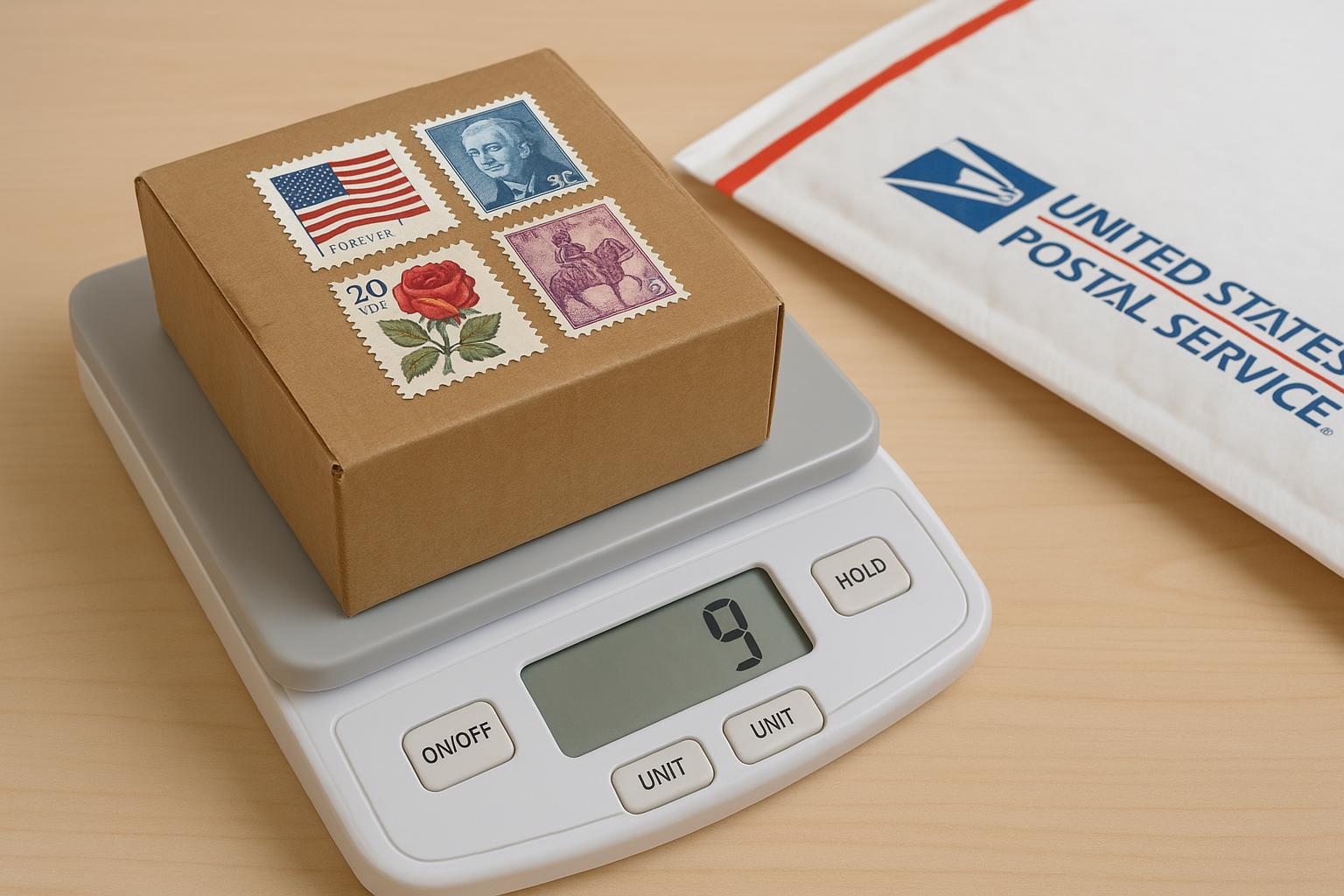
You don’t need to guess at postage. You just need a scale, a tape measure, and a clear path through USPS rules. Start there and the rest is procedural.
## How To Calculate Postage By Weight And Shape: USPS Practical Guide
The phrase “how to calculate postage by weight and shape” is straight to the point because that’s literally what determines most domestic postage. Weight tells you which rate table to use. Shape and dimensions tell you which category the item falls into: letter, flat (large envelope), or package. Combine them and you get the correct postage.
### Get The Two Core Measurements Right
Weigh It
– Use a postal or kitchen scale that reads in ounces and grams.
– If you only have a bathroom scale, weigh yourself holding the item and subtract your own weight. It’s crude but it works.
– Round up to the next ounce. USPS charges by the ounce or by pound tiers, and they’ll always charge as if you’d rounded up.
Measure It
– Measure length, width, and thickness. Use inches if you can; USPS rate charts use inches.
– Thickness matters for letters. A thin envelope and a tough, rigid one that’s the same size can be different categories.
Do this first. Most postage mistakes come from sloppy measurements.
## Shape Categories And Why They Matter
USPS doesn’t treat everything the same. Shape determines the rules for weight, surcharges, and even whether machinable discounts apply.
### Letters
Letters are thin, flexible, sealed envelopes that meet specific size and thickness rules. They move through automated sorting equipment, so there are constraints:
– Flexible and not rigid.
– Smooth, rectangular shape.
– Meets minimum/maximum length and height.
– Under a certain thickness.
If your item fits the letter definition, it’s almost always cheaper than a flat or parcel at low weights. But if it’s rigid, square, or too thick, you’ll pay a nonmachinable surcharge on top of the base rate.
### Flats (Large Envelopes)
Flats are larger or thicker than letters but still flexible. Think catalogs, thick envelopes, or booklets. They’re priced differently because they don’t go through the same high-speed letter sorters.
– Larger size limits.
– Still flexible.
– Priced by weight, but weight increments and surcharges differ from letters.
### Parcels and Packages
Once the item is rigid, bulky, or outside flat dimensions it becomes a parcel. Parcels are priced by weight and zone (distance), and for many services dimensional weight can apply. Parcels get different tracking and delivery priorities depending on the service you choose.
### Cards and Postcards
Postcards have their own rate. If you’re sending a postcard-sized card in an envelope, it might not qualify and then the letter rules apply.
## Step-By-Step Postage Calculation Process
### Step 1: Weigh And Round Up
Weigh the item with contents and packaging. If it’s 1.2 ounces, you pay for 2 ounces. That’s the single most common pitfall people miss.
Use the phrase “postage by weight” when you explain this to customers: mail is priced primarily by weight, so that rounding matters.
### Step 2: Measure And Categorize Shape
Measure length, height, and thickness. Ask: Is it flexible and smooth? If yes, test whether it meets the letter dimensions. If not, it’s a flat or parcel. This is the shape part of “how to calculate postage by weight and shape.”
Don’t guess. Small differences push an item into a different pricing lane.
### Step 3: Check For Nonmachinable Or Oversize Surcharges
Certain characteristics trigger extra charges:
– Rigid or unusually shaped mail.
– Square envelopes.
– Enclosures that make the package lumpy.
– Items requiring additional handling.
When an item is nonmachinable you pay the base rate plus a surcharge. That surcharge is fixed per piece, not per ounce, so it skews postage higher for lightweight items.
### Step 4: Pick The Service And Apply Zone Or Dimensional Rules
Service choice affects the calculation:
– First-Class Mail: usually cheapest for letters, cards, and small packages under a weight limit.
– Priority Mail: flat-rate boxes or variable pricing based on weight and zone.
– Retail Ground or Parcel Select: often used for heavier, non-urgent packages.
For many parcel services, USPS will apply dimensional weight (size-based pricing) if the package is large relative to its weight. If your package is bulky but light, dimensional pricing can increase the postage.
### Step 5: Add Extra Services
Insurance, Certified Mail, Return Receipt, Signature Confirmation — these add fixed fees. Include them after you calculate base postage.
## Practical Examples That Make Sense
Example 1: A Bill Envelope
You send an envelope with a single 2-ounce letter. You weigh it (2.1 ounces) and round to 3 ounces. You measure and confirm it’s flexible and meets letter specs. You then apply the 3-ounce First-Class letter rate, and if it’s square or rigid you add a nonmachinable surcharge.
Example 2: A Thin Booklet
A 6-ounce flexible booklet that’s too large to be a letter will be a flat. Flats are priced by weight too, but the price per ounce behaves differently. You won’t pay zone-based parcel rates unless it’s a parcel.
Example 3: A Lightweight Bulky Item
A pillowcase that’s 12 ounces but bulky might trigger dimensional weight for Priority Mail, depending on box size. If dim weight applies and exceeds actual weight, you’re charged that higher dimensional weight instead.
These examples show why shape matters as much as weight. Saying you’re doing a postage calculation without checking both is asking for surprises.
## Tools That Make Postage Calculation Faster
You don’t have to do this all in your head. Use these tools:
### Postal Scale
A small investment. Get one that measures in 0.1 ounce increments. It’s worth it.
### Ruler Or Tape Measure
Measure precisely. Thickness is the sneaky metric most people forget.
### USPS Online Calculator
The USPS website has a Price Calculator where you enter weight, dimensions, and origin/destination ZIPs. It handles zones, dimensional weight, surcharges, and shows class options. It’s the easiest for accurate postage calculation.
### Third-Party Postage Software
Services like Stamps.com or ShipStation plug into ecommerce stores and automatically calculate postage, apply commercial discounts, and print labels. If you ship a lot, they save time and money.
## Tips To Save Money On Postage
– Use the right envelope. A flimsy letter envelope that still fits letter dimensions saves money versus a thick, rigid one.
– Flatten bulky items if possible. Flexibility often keeps you in the letter or flat category.
– Look at flat-rate boxes for heavy but small items. Sometimes a Priority flat-rate box beats weight-based pricing.
– Buy postage online. Commercial rates are usually lower than retail counter prices.
– Combine shipments. One larger package can be cheaper than several smaller ones once base fees stack up.
You’ll be surprised how often minor packaging changes alter the outcome of a postage calculation.
### Watch Out For Common Mistakes
– Forgetting to include packaging weight. Boxes and padding add ounces.
– Assuming “under a pound” is always cheap. Zone and dimensional pricing matter for parcels.
– Misclassifying a flat as a letter because it looks thin but is too wide or thick.
Recieve packages with the wrong postage and they can be returned or billed. It’s avoidable with a little care.
## Special Considerations For International Mail
International postage calculation involves weight, but shape rules differ and customs forms are required. For economy services, weight is still the base factor, but the destination country and customs categories can inflate costs.
When in doubt, use USPS’s international price calculator. It will ask for weight and shape and then handle the rest.
#### Dimensional Weight Basics
Dimensional weight (dim weight) compares package volume to actual weight. If the package is large but light, the dim weight can be higher than actual weight, and USPS may bill you on the higher figure.
– Use the online calculator if you suspect dim weight might apply.
– For flat-rate boxes dim weight usually does not apply.
#### Zone Pricing For Packages
For parcels, distance matters. USPS uses zones determined by ZIP codes. Short trip across town costs less than a long-distance delivery. That’s why the same package can cost very different amounts depending on where it’s going.
## Quick Reference: What To Check Before You Buy Stamps
– Weight (rounded up).
– Shape (letter, flat, parcel).
– Thickness and flexibility (nonmachinable checks).
– Destination (domestic or international; zone).
– Service level and extras.
Completing these checks in that order turns postage into a quick calculation, not a guessing game.
### When To Visit The Post Office
If your item is weirdly shaped, oddly rigid, or you want insurance, a trip to the counter makes sense. They’ll weigh and categorize it and confirm any surcharges on the spot. But if you’re sending standard envelopes or uniform parcels, prepare them at home and use an online postage option to save time and money.
## Common Questions People Ask
How much does an extra ounce cost?
– That depends on class and shape. For letters, each additional ounce increases the cost on a specific schedule. Flats and parcels follow different increment rules. You’ll need the current USPS rate chart or the online calculator for exact amounts.
Can I use stamps for large envelopes?
– Yes, but count carefully. Retail counters will accept stamps, but bulk or heavy mail is easier paid with a printed label. Stamps can be cumbersome for higher postage amounts.
What if my package is slightly too big for a flat?
– Then it’s a parcel. That changes the pricing structure and may introduce zone-based charges or dimensional weight considerations.
Remember that “postage calculation” is a small set of repeated checks: weight, shape, dimensions, and service. Keep those in order and the math becomes simple.
## Where People Trip Up
– Estimating instead of measuring. Eyeballing thickness leads to misclassification.
– Ignoring surcharges. Nonmachinable and oversized fees add up quickly.
– Not considering the packing material. Bubble wrap and boxes can tip a piece into the next weight band.
Do the quick checks and you avoid fees and returned mail.
## Tools And Terms To Know
– Postal Scale: Measures weight precisely.
– Price Calculator: The USPS web tool that handles zones, dim weight, and services.
– Nonmachinable Surcharge: Extra fee for items that can’t be processed by machine.
– Dimensional Weight: Pricing based on volume when it outpaces actual weight.
– Flat-Rate Box: Fixed-price option irrespective of weight (within limits).
If you use these tools regularly, postage calculation becomes second nature.
## Final Practical Walkthrough
1. Put the item in its final packaging.
2. Weigh it and round up to the next ounce.
3. Measure length, width, thickness.
4. Decide if it’s a letter, flat, or parcel.
5. Check for nonmachinable characteristics.
6. Choose the mailing service.
7. Use the USPS calculator or a third-party tool to compute postage.
8. Add insurance or signature services if needed.
9. Print the label or affix stamps and drop it off.
This is the simplest path to accurate postage. It’s methodical and repeatable. No guesswork. Just a small process anyone can adopt. Just one more note: if you ship often, tracking the few exceptions you encounter will make your future postage calculations faster and more accurate overall.

Leave a Reply