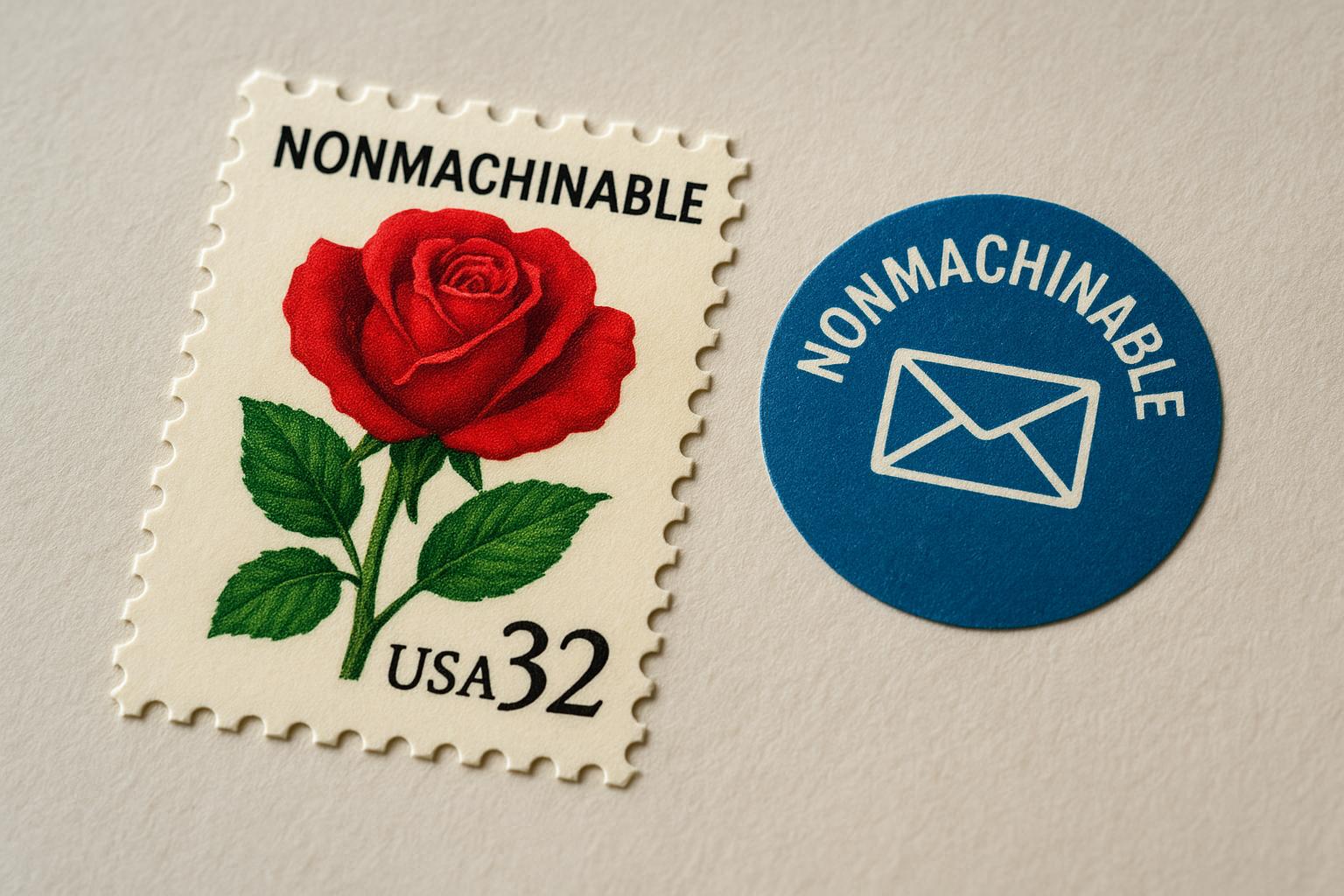
If the post office tells you something is nonmachinable, treat that as a heads-up: the piece needs human hands and it will cost you a bit more.
## Nonmachinable Stamp Explained: How It Works
Put simply, nonmachinable stamp explained means the USPS has a category for mail that won’t safely run through automatic sorters. The term bundles two ideas: the physical condition of the piece and the postage required to cover extra handling. That’s why someone selling postage will say the rate is for nonmachinable items, or a clerk will ask if an envelope is machinable.
When a piece is nonmachinable mail, it’s not condemned or illegal. It just needs to be handled differently. Machines are fast and efficient. Anything that risks jamming or misfeeding gets redirected to manual processing, and manual processing costs more.
### Why Items Are Flagged
There are practical, repeatable reasons a piece gets labeled nonmachinable. If it’s too thick, too rigid, oddly shaped, or has elements that could snag a machine, it won’t pass. Even something as small as a metal clasp or a glued-on embellishment can make the difference.
### Physical Criteria That Matter
The USPS lists dimensions and thresholds, but the easiest way to judge is tactile: does the item bend when you press it with two fingers? If not, it’s suspect. Square envelopes, unusually small or large pieces, and anything with hard components are likely candidates for nonmachinable status.
#### Size And Thickness
Letters must fall within defined min and max sizes and under a certain thickness to be machine-fed. A stiff card with multiple layers often exceeds the thickness limits even if it looks like a normal envelope.
#### Rigid Contents And Odd Shapes
Small keys, coins taped inside, thick invitation inserts, or anything that creates a lump can render a piece nonmachinable mail. The problem is not just that the machine can’t read it; the piece can damage the equipment or get ruined in the process.
### Examples You’ll See At The Counter
Common nonmachinable mail examples are wedding invitations with heavy cardstock, square thank-you cards, envelopes with clasps, and packages with hard inserts. Bubble mailers with a rigid tray also frequently land in this category.
## Pricing And Postage For Nonmachinable Items
The cost is the reason most people notice the designation. You pay the regular first-class rate plus a nonmachinable surcharge for letters. That surcharge isn’t arbitrary; it covers the extra labor and different routing the piece will take.
### Do You Need A Special Stamp?
No, USPS does not require a uniquely printed adhesive called a nonmachinable stamp for every instance. You can use any combination of postage that equals the required amount. Still, the phrase nonmachinable stamp is commonly used by staff and in some instructions to indicate the correct rate when you buy a single stamp at the counter. In practice, you can pay with forever stamps, metered postage, or printed online labels as long as the total equals the nonmachinable price.
### How Much Extra Will You Pay?
Rates change, so check current USPS tables. For a typical lightweight letter that’s nonmachinable, the surcharge might be a modest number of cents; for thicker or heavier items the fee increases. The point is: design choices that push your piece into nonmachinable status carry recurring costs if you mail often.
## Nonmachinable Stamp Explained In Practical Terms
Think of nonmachinable stamp explained as shorthand for the decision process: is this item safe for the machines, and if not, how much more will I pay? It’s a label applied at several points—by clerks, by automated kiosks, and by sortation supervisors.
People sometimes expect a special sticker or sheet that says nonmachinable. They recieve a price flag instead. The label itself is operational, not ornamental.
### Where The Label Comes From
Sorting equipment can flag a piece, or a person at the counter can make the call. When flagged, the piece is diverted to a manual bin, a clerk may examine it, and postage is checked against the appropriate rate. That human touch creates cost and the reason for different pricing.
### Visual Clues To Inspect Before Mailing
Before you drop something in a mailbox, do a quick check: will the item bend? Is it square? Does it have hard bits or glued-on things? If the answer is no to bendability or yes to any of the other issues, plan for nonmachinable mail treatment.
## How Processing Differs For Nonmachinable Mail
Machine-routed mail moves through a set of automated steps that scan, orient, and route items by the second. Nonmachinable mail gets boxed for hand-sorting. That means different facilities might touch it, and the timeline can shift.
### Manual Handling Steps
Once diverted, a clerk typically separates nonmachinable mail, applies hand-canceling, and bundles for transport. It still travels through the USPS network, but the piece doesn’t enjoy the same conveyor-belt speed. For valuable items, this manual route can be an argument for adding tracking anyway.
### Why Tracking Matters
Because nonmachinable mail moves by hand, visibility into where it is and whether it’s been processed can matter more. A tracked label reduces the chance of mystery delays and gives you proof if something goes astray.
## Buying Postage: Nonmachinable Stamp Explained For Senders
At the point of sale, the process is straightforward. Tell the clerk the item’s class and whether it’s machinable. If it’s not machinable, the clerk will calculate the nonmachinable rate. You can pay that with any mix of stamps or printed postage.
### Online And Metered Options
If you use online postage, the software usually asks if the mail is machinable. If you answer no, it computes the correct rate automatically. That prevents underpaying and the awkwardness of getting a bill later.
### Using Forever Stamps
To cover the surcharge with forever stamps, add enough stamps to meet the nonmachinable total. People commonly slap an extra stamp on and call it good; clerks accept that. If you’re mailing in volume or often sending bulky letters, set your meter or postage software to the nonmachinable option and avoid the guesswork.
### Nonmachinable Stamp Explained For Everyday Mailers
For most everyday users, the rule of thumb is simple: if it doesn’t bend, expect to pay more. The phrase nonmachinable stamp explained is less about buying a new kind of stamp and more about understanding that your design choices affect postage and handling.
#### Nonmachinable Stamp Explained: Real-World Example
You have a square invitation, two inserts of heavy cardstock, and a decorative clasp. At the counter, the clerk checks dimensions, flexes it, and says it’s nonmachinable. You pay the regular stamp plus the surcharge, and the piece is set aside for hand processing. That’s nonmachinable mail in action.
## When To Accept The Surcharge And When To Avoid It
If a piece is fragile or you don’t want folding, accept the surcharge and add tracking. If your goal is low cost and fast delivery, redesign the piece to meet machinability standards. Small changes—using a lighter insert, switching to a rectangular envelope, or removing metal—can save repeated fees.
### Mistakes That Cause Surprise Charges
Senders often underestimate how much glue, decoration, or thickness pushes an item over the threshold. People also assume that if an envelope fits in a mailbox it’s fine. Not always. The machines care about shape and feed characteristics, not where you dropped it off.
### Alternatives To Paying The Surcharge
If you must send something rigid, consider a small parcel rate or a padded flat-rate envelope that’s designed for machine handling. Those options can sometimes be cheaper than paying repeated nonmachinable surcharges while preserving the item.
## How Retail And Business Mail Differ
Businesses that mail in volume usually have systems to avoid nonmachinable classifications unless they choose them. Retailers print postage with correct indicators and use compliant envelopes to stay within machinable limits. For individuals, a quick check at the post office or using online postage tools reduces surprises.
### Practical Tips For Frequent Mailers
Make a quick checklist: remove metal, avoid squares, keep thickness below a quarter-inch for standard letters, and use envelopes intended for mailing. If you’re producing invitations or promotional mail, ask your printer about mailability; they deal with these constraints regularly.
A small piece of awareness at the design stage saves time and money down the road. If your project must include heavier materials, budget for nonmachinable mail fees and add tracking to protect your investment.
Leave a Reply