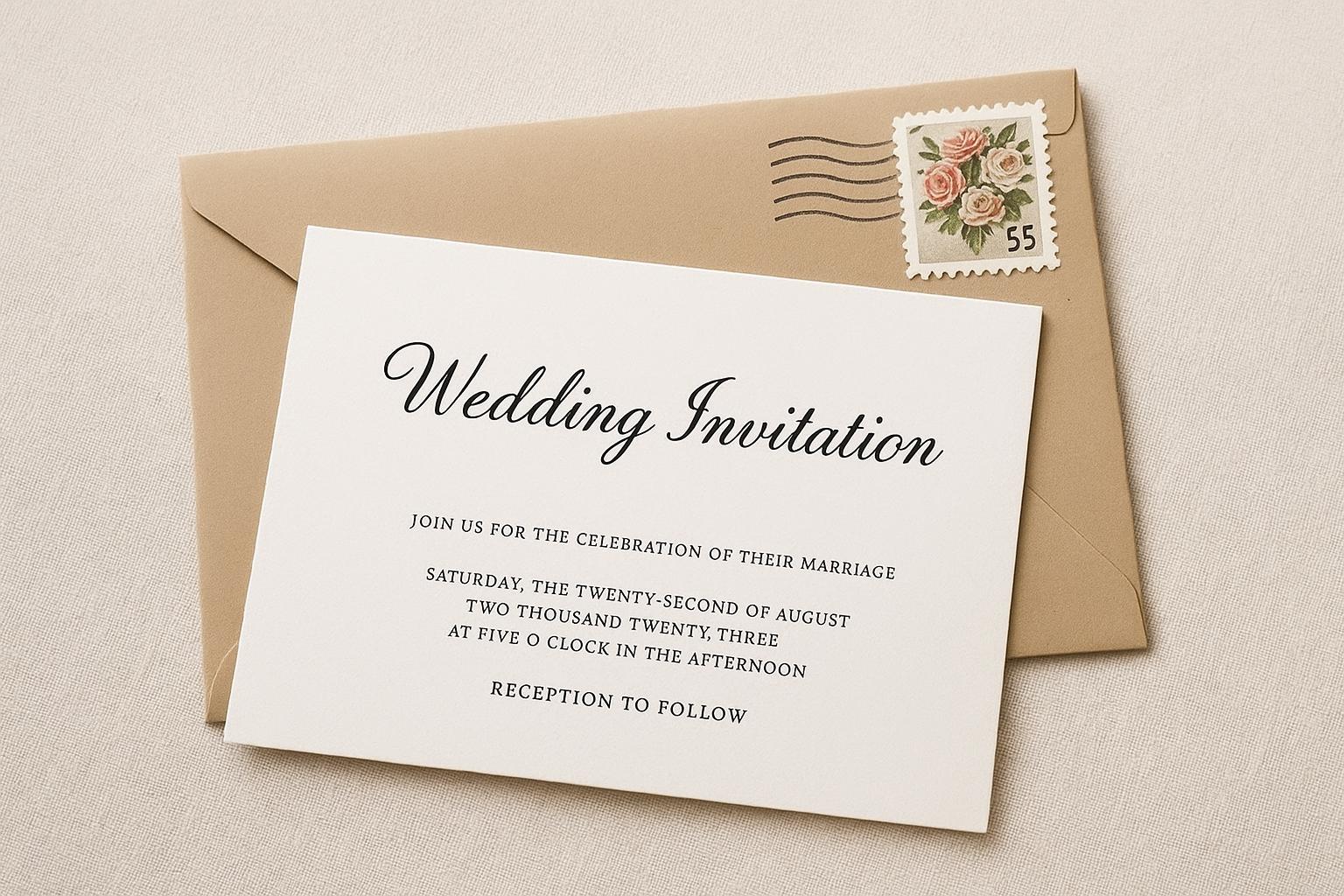
Wedding invitations are where postage quietly goes wrong. The invitation itself weighs more than a normal letter, the envelope is often square, and there’s usually a second envelope inside for the RSVP. Any one of those can push the price past a single Forever stamp, and finding out after you’ve mailed two hundred of them is an expensive way to learn. The same two tests decide the postage on an ordinary greeting card or an oversized postcard, so this page covers those as well. Here is what the current rates actually are.
The base rate for a letter
A standard First-Class Mail letter weighing one ounce or less costs 82 cents, which is the value of one Forever stamp. The 82 cent rate took effect on July 12, 2026. A wedding invitation qualifies for the 82 cent rate only when the assembled invitation weighs one ounce or less and the envelope meets the Postal Service requirements for machinable letter mail.
Most assembled wedding invitations do not meet both of those conditions at once, which is why a single Forever stamp is frequently insufficient.
Current First-Class Mail prices
| Mail piece | Price |
|---|---|
| Letter, one ounce or less | $0.82 |
| Letter, two ounces | $1.11 |
| Each additional ounce | $0.29 |
| Nonmachinable surcharge | $0.49 |
| Large envelope or flat, first ounce | $1.69 |
| Postcard | $0.65 |
The prices in the table above took effect on July 12, 2026 and are published by the Postal Service in the retail price list known as Notice 123.
When the nonmachinable surcharge applies
A nonmachinable surcharge of 49 cents applies to any letter that cannot be processed on automated Postal Service equipment. The surcharge is applied in addition to the postage that the weight of the letter requires, rather than in place of that postage. A two-ounce square invitation therefore costs $1.11 in weight-based postage plus the 49 cent surcharge, which produces a total of $1.60.
The characteristics that make a letter nonmachinable are defined by the Postal Service in the Domestic Mail Manual at section 101.1.2. The characteristics most commonly encountered in wedding stationery include a square envelope, an envelope containing rigid or uneven contents that prevent the envelope from bending, a closure using a clasp, string, button or ribbon, and an envelope whose length divided by its height falls outside the range the Postal Service accepts.
Square envelopes are the single most common cause of a surcharge on wedding mail, because a square envelope has a length-to-height ratio of one and automated equipment cannot determine the orientation of a square envelope.
Weight is the second variable
An assembled wedding invitation frequently exceeds one ounce, because the assembled invitation includes the invitation card, an RSVP card, an RSVP envelope, and in many cases a details card, a belly band, or a vellum overlay. A two-ounce letter costs $1.11, and each ounce beyond the second adds 29 cents.
Weight and machinability are assessed independently of one another. An invitation may be charged the two-ounce rate without incurring a surcharge, or may be charged the one-ounce rate plus a surcharge, or may incur both. The two assessments are not alternatives to one another and are not interchangeable.
Greeting cards and everyday invitations follow the same two tests
The two tests that decide the price of a wedding invitation decide the price of any card sent in an envelope, and the two tests are weight and machinability. A greeting card in a standard rectangular envelope weighing one ounce or less requires eighty-two cents, which is one Forever stamp, and no surcharge is due. A greeting card requires more than eighty-two cents when the card and envelope together exceed one ounce, or when the envelope fails one of the machinability conditions described above.
The cards that most often require more than one Forever stamp are square cards, cards sent in envelopes closed with a ribbon or a button, cards containing a rigid insert such as a gift card holder or a photograph mounted on board, and cards that include an enclosure heavy enough to push the total past one ounce. A musical card containing a sound chip is nonmachinable in every case, because a musical card does not bend and the thickness of a musical card is uneven.
| Card and envelope | Postage due | Why |
|---|---|---|
| Standard rectangular card, under 1 oz | $0.82 | One Forever stamp, no surcharge |
| Square card, under 1 oz | $1.31 | $0.82 plus the $0.49 nonmachinable surcharge |
| Standard rectangular card, 2 oz | $1.11 | Weight only, no surcharge |
| Square card, 2 oz | $1.60 | $1.11 plus the $0.49 nonmachinable surcharge |
| Musical or rigid card, under 1 oz | $1.31 | Nonmachinable regardless of shape |
Oversized postcards are charged as letters rather than as postcards
The postcard rate of sixty-five cents applies only to a card that falls inside the Postal Service size limits for a postcard, and a card that exceeds any one of those limits is charged as a letter instead. A postcard qualifies for the sixty-five cent rate when the postcard is rectangular, is at least 3.5 inches high and 5 inches long, is no more than 4.25 inches high and 6 inches long, and is between 0.007 and 0.016 inches thick.
A card that is larger than 4.25 by 6 inches is charged the letter rate of eighty-two cents rather than the postcard rate of sixty-five cents, and the difference of seventeen cents is the reason oversized promotional postcards are frequently returned for postage due. A card thicker than 0.016 inches is charged the letter rate for the same reason. A card that is larger than the letter maximum is charged the large envelope rate of one dollar and sixty-nine cents.
The practical rule is that the sixty-five cent postcard rate is narrow, and that any card outside the standard postcard dimensions should be assumed to cost eighty-two cents until the card has been measured against the limits above.
The RSVP envelope is priced separately
An RSVP envelope enclosed inside an invitation is mailed as its own separate piece of mail when the recipient returns the RSVP envelope, and the RSVP envelope requires its own postage at the rate that applies to the RSVP envelope on its own. An RSVP envelope that is a standard rectangular envelope weighing under one ounce requires 82 cents, which is one Forever stamp. An RSVP envelope that is square requires 82 cents plus the 49 cent nonmachinable surcharge, which is $1.31.
An RSVP card sent as a postcard rather than in an envelope is charged the postcard rate of 65 cents, provided the RSVP card meets the Postal Service size requirements for a postcard.
Large envelopes are a separate category
An invitation mailed in an envelope larger than the maximum dimensions for letter mail is classified as a large envelope, also called a flat, and is priced from a separate rate table. A large envelope costs $1.69 for the first ounce. The nonmachinable surcharge does not apply to a large envelope, because the large envelope category is priced separately from letter mail rather than as a variation of letter mail.
How to confirm the price before buying stamps in bulk
The reliable method is to assemble one complete invitation exactly as the invitation will be mailed, including every insert, the inner envelope, the RSVP envelope, and any ribbon or seal, and to present that assembled invitation at a Post Office counter for weighing and assessment. A Postal Service clerk assesses both the weight and the machinability of the assembled invitation and states the exact postage required.
Presenting an assembled sample is more reliable than calculating the postage from a published table, because machinability is determined by physical handling characteristics that a table cannot assess. Confirmation should be obtained before postage is purchased in quantity, since postage purchased at the wrong denomination cannot be exchanged for cash at a Post Office.
Left with stamps after the cards go out?
Most couples over-buy, and so does anyone who bought a roll for the holidays. If you’re left with a stack of Forever stamps, extra-ounce stamps or unused nonmachinable stamps once the mail has gone out, we’ll buy them for cash. We pay 50 percent of face value on all Forever stamps, and you’ll see the offer before you ship anything. Start on the cash for stamps page, or look at the full rates first.
We’ve paid out over $5 million to more than 2,200 customers since 2020. Leftover wedding and holiday postage is one of the most common things people send us.

Leave a Reply