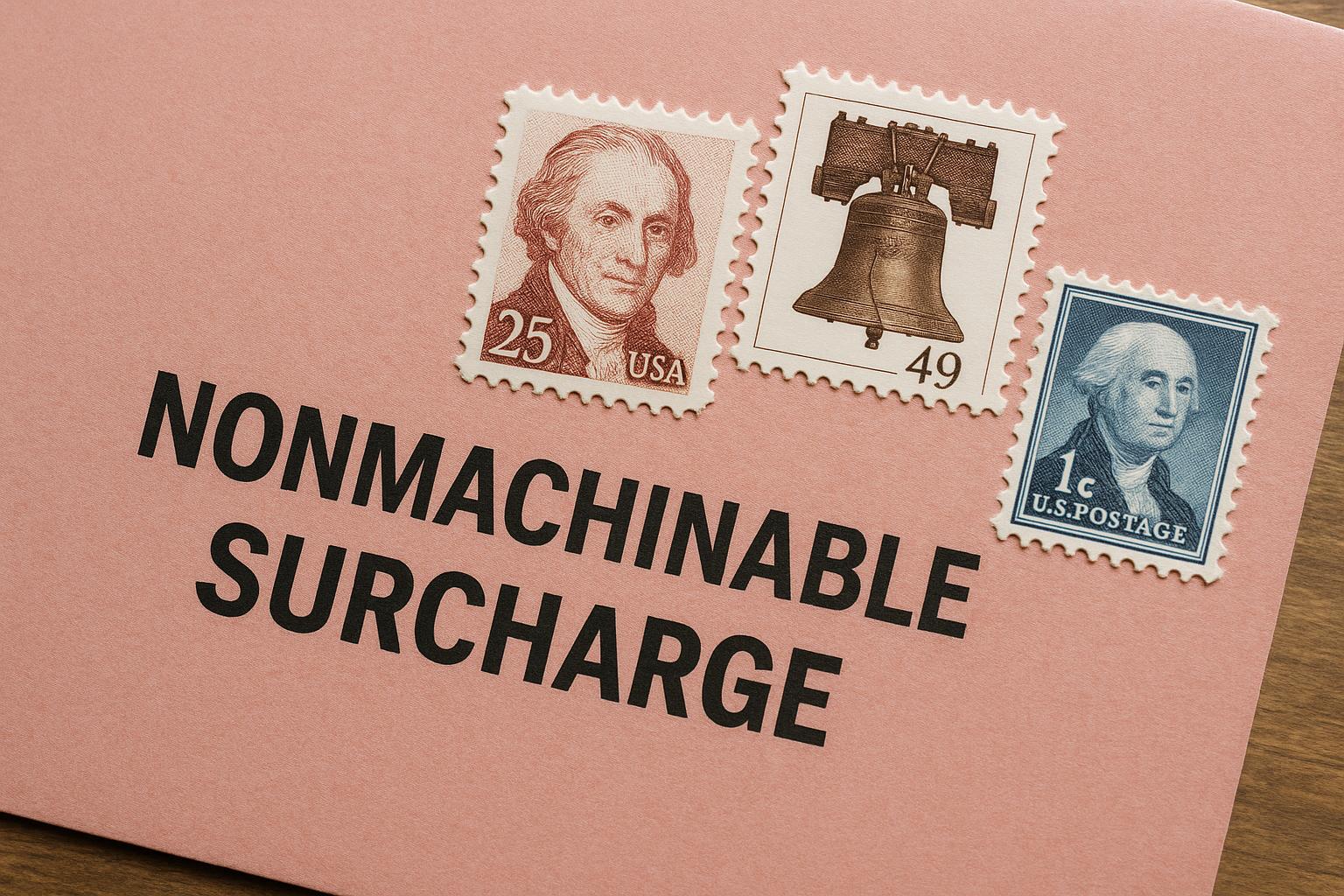
Postal sorting machines are picky. If your mail piece doesn’t meet their idea of “standard,” you’ll pay extra. That extra fee shows up as a nonmachinable surcharge, and it can quietly add 20–40% to single-piece postage if you’re not careful.
## Nonmachinable Surcharge Explained For Mailers
The phrase nonmachinable surcharge explained covers what triggers the charge and how it’s applied. In plain terms: when a letter or card can’t be processed through automated equipment, the postal service treats it differently and charges a higher price or a specific surcharge. This isn’t punishment — it’s compensation for manual handling. But knowing the rules lets you design mail to avoid the fee most of the time.
### What Makes Mail Nonmachinable
There’s a cluster of physical traits that commonly trigger the nonmachinable surcharge. Think of things that block rollers, jam feeders, or prevent clean scans.
– Rigid or stiff pieces: thick cardboard inserts, rigid enclosures, or items that don’t bend easily.
– Uneven thickness: bulky corners or lumpy contents like clasps, buttons, or rigid folds.
– Square envelopes: no corners for the machine to square off.
– Non-uniform sizes: too small or oddly shaped pieces.
– Protrusions: strings, ribbons, clasps, or anything that sticks out.
– Seams and fasteners: metal clips, staples, or exposed fasteners.
– Extra thickness: many postal services list a minimum and maximum thickness; exceeding that pushes a piece into nonmachinable territory.
Those traits move your piece out of automated lanes and straight into a pile for hand-sorting — hence the nonmachinable surcharge.
### How The Fee Is Applied
The nonmachinable surcharge is added on a per-piece basis. If your envelope is a regular First-Class letter but fails machinability tests, you’ll pay the standard postage plus the surcharge. For bulk or presorted mail, some of the requirements change, but if even a portion of a mailing is nonmachinable, you can’t count on automation discounts for those pieces.
Nonmachinable rate differentials also exist. That term — nonmachinable rate — refers to the adjusted postage level applied to items that can’t be processed by machines. It’s not a single universal number; the actual cost depends on the class of mail, whether it’s single-piece or commercial, and current postal pricing.
#### Examples That Cost Money
A rigid invitation with a cardboard backing. A square envelope with no usable corner. A greeting card with a foil closure or a button. These are classic triggers. Even a thin ribbon glued to the inside of an envelope can misalign the piece enough to cause a surcharge.
### How To Avoid Paying The Surcharge
You don’t need exotic solutions. Small design and packing choices make a big difference.
– Use flexible, standard-size envelopes and avoid square formats.
– Remove stiff inserts or use thinner stock that flexes.
– Avoid metal clasps, exposed fasteners, or bulky seals.
– Keep thickness and dimensions within the postal service’s machinable ranges.
– If you need to send an odd shape or a rigid item, choose the correct class up front (flats or parcels) rather than forcing it into a letter rate.
For printed campaigns, test one piece at the post office before producing thousands. Their staff can often point out a specific problem that’s easy to fix.
### Bulk Mail And Automation Considerations
If you’re a business sending many pieces, the rules shift a bit. Automation discounts require pieces to meet stricter standards: accurate barcodes, consistent placement, and precise dimensions. A single nonmachinable item in a mailing might disqualify that piece from automation pricing, but it won’t necessarily blow up the whole job if you’ve followed bulk mailing guidelines.
Commercial printers and mail houses usually have machinery and techniques to reduce nonmachinable rates, like flexible inserts or specially scored envelopes. They charge for that service, but it often costs less than paying the surcharge on every piece.
#### When Paying The Surcharge Makes Sense
Sometimes it’s cheaper to accept the surcharge than to change the product. A thick, premium invitation may sell itself precisely because it feels substantial. In those cases, calculate the total cost: higher postage plus the perceived value might still be the best move. Just don’t be surprised when the invoice for postage arrives.
### Practical Steps For Mail Designers
Start with the postal manual or the online machinability guide for your carrier and keep a simple checklist on the production floor. If your mail falls just over a limit, consider minor edits: swap to a lighter paper, remove an inner stiffener, or change the envelope flap. Those small moves can shift a piece from nonmachinable rate back to standard letter pricing.
If you ever need to dispute a surcharge, hold on to tracking and samples. Inspectors can review items and sometimes reclassify them, but that’s not a strategy for every day.
A last note: always proof a mailing with one or two real samples and, if possible, run them at a local post office. Seeing a clerk’s reaction is a quick, low-cost way to avoid surprises later. And yes, I once watched a whole nonprofit rework a campaign after a single test piece failed—saved them hundreds in postage after a few small changes. The reciepient appreciated the nicer envelope too.

Leave a Reply