The emergence of adhesive postage in the United States replaced a patchwork of regional practices and variable postage charges with a uniform and practical system. Examining the primary legislative actions, the design and production of the first issues, and the immediate reception by postal users offers a clear picture of how modern American mail service began to incorporate prepaid stamps.
## When Was The First US Postage Stamp Issued A Brief History
The question when was the first us postage stamp issued occupies a precise place in American postal chronology. Officially, the earliest authorized adhesive stamps of the United States were issued in 1847. Those first issues marked the transition from a system in which the recipient commonly paid postage upon delivery to one that allowed prepayment, simplifying transaction and accounting for the rapidly expanding mail networks of the antebellum era.
### Legislative And Postal Reform Precursors
Long Before The 1847 Issue
Postal reform in the United States unfolded across the 1830s and 1840s, influenced by both domestic pressures and international developments such as the United Kingdom’s Penny Black of 1840. Reforms in the United States focused on standardizing rates, simplifying distance-based tariffs, and encouraging timely payment. A series of congressional acts reduced and standardized postage rates during the 1840s; those rate changes directly precipitated the practical need for adhesive stamps. When was the first us postage stamp issued is therefore tied not only to a date but also to a sequence of postal reforms that made such an instrument both feasible and useful.
### The Date And The Designs
The 1847 Issues In Detail
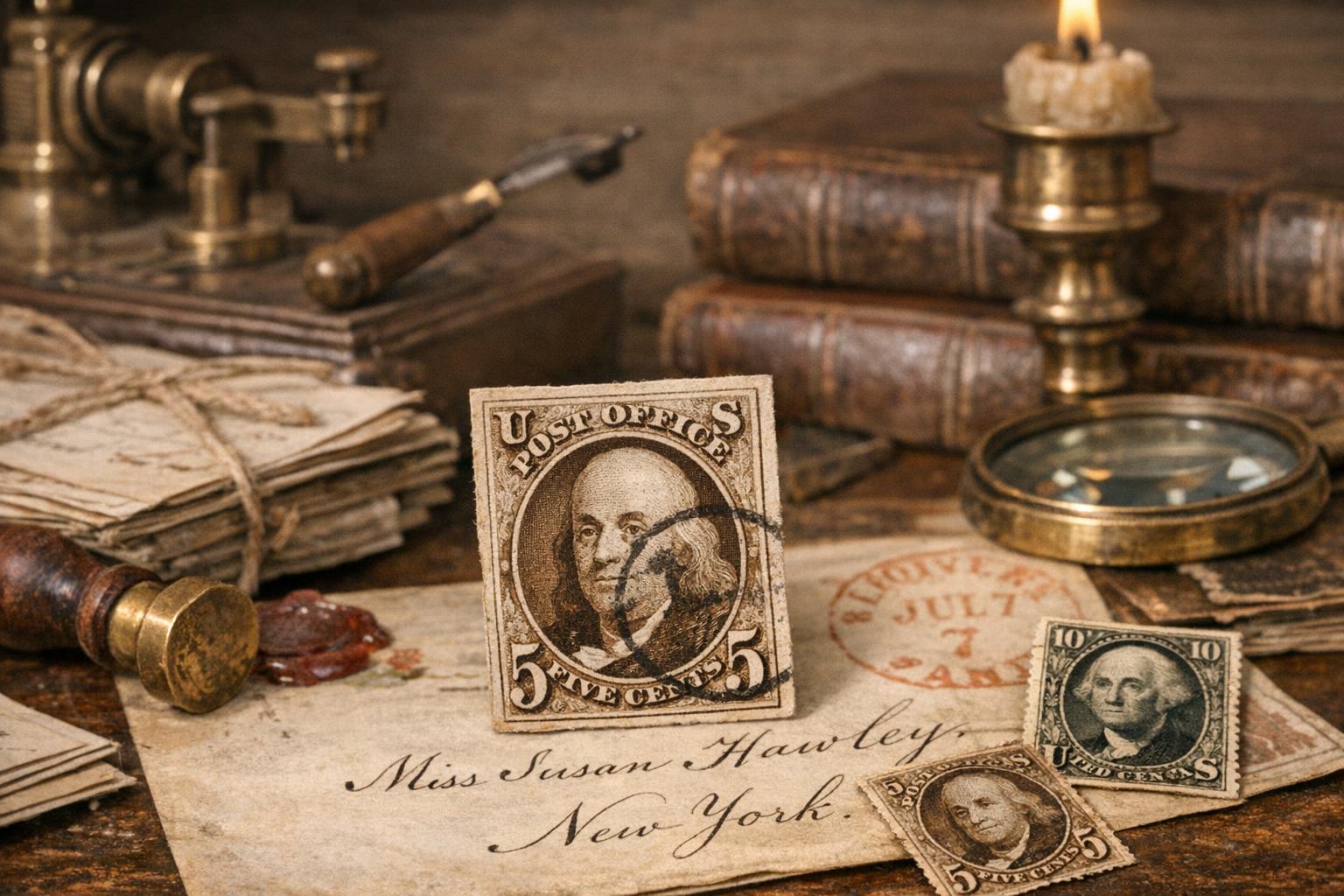
To answer precisely when was the first us postage stamp issued: the Post Office Department placed the 5-cent and 10-cent adhesive stamps into circulation on July 1, 1847. The 5-cent denomination depicted Benjamin Franklin; the 10-cent denomination portrayed George Washington. These values corresponded to the prevalent postage rates after the reductions: 5 cents for letters weighing up to half an ounce carried a specified distance (generally under 300 miles), and 10 cents for longer distances. The plates and printing work were produced by the New York firm Rawdon, Wright, Hatch & Edson, and the images were based upon well-known portraiture to provide immediate recognition and respectability.
#### Design Choices And Production Methods
Engraving And Print Runs
The engravings were technically sophisticated for their time: intaglio work imparted fine detail and made counterfeiting more difficult. Production quality varied with different print runs and plate maintenance; collectors and historians studying us stamp history often analyze plate wear and re-entries to date specific examples. The first us stamp run was enough to satisfy anticipated demand in 1847, but usage patterns and regional distribution meant that examples from early deliveries are prized by specialists.
### Postal Usage And Public Reception
How The Public Adopted Prepaid Adhesives
When was the first us postage stamp issued had practical consequences almost immediately. Prepaid adhesive stamps simplified the payment process and reduced the incidence of undelivered, unpaid mail. Postmasters rapidly incorporated the new stamps into routine transactions. However, full acceptance was gradual because the public had long been accustomed to paying on receipt, and some communities lacked immediate access to official stamp stocks. As distribution and public familiarity expanded, the stamps grew in everyday utility.
### Place In Us Stamp History
Significance For The Postal System
Within the broader sweep of us stamp history, the 1847 issue represents the formal adoption of adhesive prepayment in federal mail operations. Its significance is both procedural and symbolic: it applied a reproducible, recognizable medium for prepayment and aligned the United States with an international trend toward standardized, adhesive postage. Scholars of us stamp history note that the 1847 stamps are the logical starting point for the chronological study of federal adhesive issues, and their introduction set design and administrative precedents that influenced later issues through the mid-nineteenth century.
#### Transition To Later Issues
From 1847 To 1851 And Beyond
The original 1847 stamps were superseded by a new set in 1851 that responded to further rate adjustments and changing aesthetic and security considerations. The replacement issues expanded denominations and modified designs, but their lineage is directly traceable to that first federal experiment. Those studying when was the first us postage stamp issued frequently examine the transition from the 1847 pair to the 1851 series to understand evolving postal policy and production techniques.
### Collecting And Authentication Considerations
Why The 1847 Pair Is Sought By Collectors
Collectors prize the 1847 pair—commonly referred to in catalogs as the first us stamp pair—for scarcity in well-preserved condition and for the historical moment they represent. Authentication requires careful scrutiny of paper type, impressions, postmarks, and plate characteristics. Counterfeits and forgeries have existed since the earliest days of philately; therefore, provenance and expertizing certificates often accompany significant examples. Enthusiasts who research when was the first us postage stamp issued typically consult postal records, contemporary postmaster circulars, and early usage covers to corroborate claims of date and authenticity.
### Legal And Administrative Records
Documentary Evidence For The Issuance
Primary documentation clarifies when was the first us postage stamp issued: official Post Office Department notices, postmaster circulars, and governmental records record the authorization, printing orders, and distribution schedules that culminated on the established issuance date in 1847. These documents also illuminate matters of accounting, such as the allocation of printed sheets to individual post offices and the handling of unsold stock. Archival evidence confirms both the date and the administrative intent behind the issuance.
#### Notable Early Covers And Postal Rates
Rare Examples And The Rate Structure
Early mailed covers franked with the 5¢ and 10¢ stamps provide tangible evidence of use and rate application. Postal historians have cataloged numerous notable covers that demonstrate the stamps’ roles in interstate and long-distance correspondence. Analyzing these covers helps answer questions about actual usage patterns and the effectiveness of the new prepayment regime after when was the first us postage stamp issued.
### Continuing Research And Interpretive Questions
Ongoing Work In Philately And Postal History
Research into the period continues to refine understanding of distribution logistics, regional adoption rates, and printing variables. Scholars and dedicated collectors collaborate to update records relevant to when was the first us postage stamp issued and to situate the 1847 issues more precisely within broader social and technological contexts. Interdisciplinary approaches drawing upon archival science, economic history, and art history enrich interpretations of these early adhesives and their impact upon communications in the United States.
For researchers focused on when was the first us postage stamp issued, the 1847 pair remains a pivot point for studies in early federal postal administration, design selection, and public adaptation to prepaid postage. Detailed examination of the primary and secondary evidence yields both clarity and continuing avenues for inquiry within the field of us stamp history
Leave a Reply