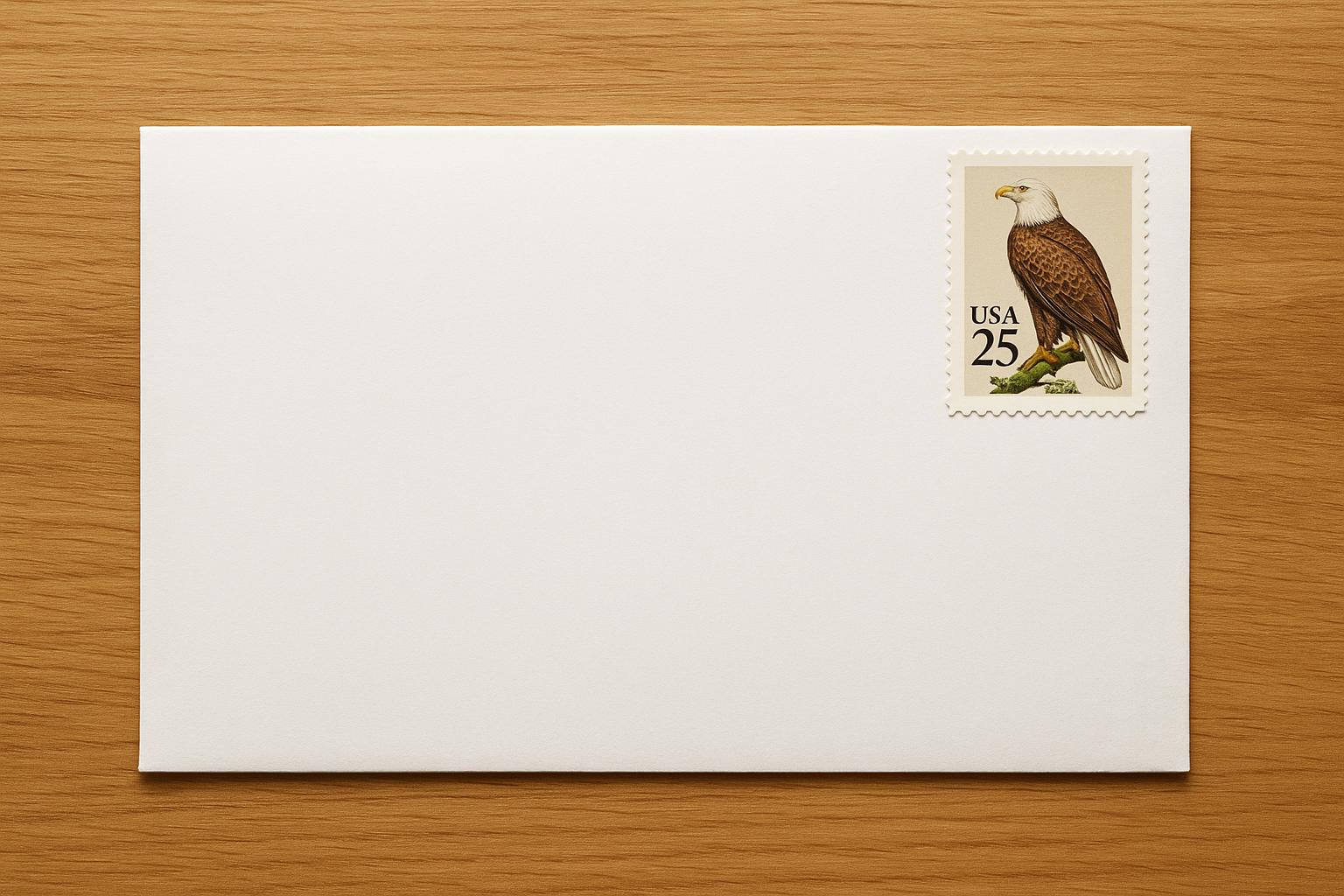
You can send a simple folded letter with a single First-Class stamp if the envelope meets the USPS size and weight rules. It’s about inches and ounces, not luck.
## Letter Envelope Dimensions For One Stamp: The Exact Limits
The core rule to remember: a one-stamp letter must be within the USPS letter-size dimensions and weigh 1 ounce or less. The formal size range for a machinable First-Class letter is at least 3-1/2 inches high by 5 inches long, and no larger than 6-1/8 inches high by 11-1/2 inches long. Thickness matters too: generally that keeps you under 1/4 inch. If any of those measurements are exceeded, you’ll need extra postage.
If you’re trying to figure out letter envelope dimensions for one stamp, measure your finished envelope after inserting its contents. Folding a single sheet of paper once usually keeps you inside the limits. Fold twice and you might hit the thickness ceiling.
### Why Size And Weight Both Matter
Postage requirements don’t hinge on a single number. The USPS treats a piece of mail as a “letter” only when it matches a bundle of criteria: rectangular shape, flexible, single-piece construction, and those specific min/max dimensions. Weight is the easy part: one First-Class stamp covers up to 1 ounce. Anything heavier adds postage in ounce increments.
That’s why you can have a perfectly sized envelope that still needs more postage if it’s stuffed with photos, card stock, or heavy inserts. Conversely, a light postcard that’s too small or square could also demand additional postage because it fails the size/shape test.
### Standard Envelope Size Versus One-Stamp Reality
When people say standard envelope size, they usually mean the #10 envelope — about 4 1/8 by 9 1/2 inches. That fits neatly inside the allowable letter dimensions and, with a single sheet of paper folded in thirds, it’s typically a one-stamp envelope. The #10 is the practical default for bills, business letters, and personal notes. If you use it, measure after sealing to be sure nothing bulges.
A square envelope or an odd-shaped craft piece? Those are trouble. The USPS considers square envelopes non-machinable, which often doubles or adds a surcharge. So even if your dimensions fall within the numeric limits, shape can make a “one stamp envelope” requirement go up.
#### Tips For Hitting The One-Stamp Target
– Use standard paper (20-24 lb) and fold once for a single-sheet letter.
– Avoid bulky inserts like thick greeting cards or multiple photos.
– Keep the envelope rectangular and smooth; avoid rigid items or glued corners.
– If you have a narrower or shorter envelope, confirm it meets the 3.5 x 5 inch minimum.
### Practical Measurements That Work
Here are some examples that match common items:
– A single 8.5 x 11 sheet folded in thirds into a #10 envelope: fits and typically stays under 1 ounce.
– A single A4 sheet folded twice into an A2 envelope (4.375 x 5.75): check the thickness; often OK with light paper.
– Two sheets of 20 lb paper plus a light return envelope inside a #10: likely over 1 ounce.
If your goal is to be absolutely sure the postage will be just one stamp, weigh the sealed envelope on a postal scale or at USPS retail. If you don’t have a scale, use a kitchen scale and round up conservatively.
### Visual And Machinability Rules
Machines sort most First-Class letters. Mail that’s too rigid, too lumpy, or too square won’t run through these machines properly, and the USPS charges a non-machinable surcharge. That means a neat square craft envelope might need extra postage compared with a standard envelope of the same area. So even if you’ve studied letter envelope dimensions for one stamp, remember the shape and flexibility rules.
### When A Standard Envelope Size Fails
You can still send a nonstandard envelope, but expect to pay more. Oversized or thick items are reclassified as flats or parcels, with higher rates. For example, if your envelope is thicker than 1/4 inch or longer than 11-1/2 inches, you’re in flat territory. Flats have larger minimums for weight and cost.
If your stationery is fancy—embossed, lined, or made of heavy paper—test a sample. Fancy materials can push you over the 1-ounce mark without you noticing. I once mailed five RSVP cards in an elegant lined envelope thinking one stamp would do. It didn’t. Learned the hard way.
#### Making Homemade Pieces Mail-Friendly
If you like crafting envelopes, here are a few practical moves:
– Use single sheets of lighter-weight paper for inserts.
– Skip the wax seals or add them on the interior side instead.
– Keep corners trimmed so they don’t create pressure points against sorting machines.
These steps increase the odds your creative mail stays a one stamp envelope.
### How To Measure Correctly At Home
To check letter envelope dimensions for one stamp, do this: seal the envelope, flatten it gently, then measure length and height with a ruler. Use a caliper or a firm measurement for thickness at the center. If you don’t have a reliable scale, bring a sample to a post office counter and ask them to weigh it. They’ll tell you if it’s a one-stamp job or not.
### Address Placement And Stamp Position
Beyond dimensions, placement matters. Stamps go in the upper-right corner and addresses should be parallel to the longest side. Mail that’s misaddressed might not be rejected, but it can slow processing or cause additional handling that could result in a surcharge. Keep it simple: clear address, right corner stamp, and no extra stuff on the front.
### Pricing Changes And Staying Up To Date
Postal rates and specific machinability rules change occasionally. If you plan to send dozens of mail pieces, check the USPS website for the current First-Class letter rate and the detailed size/weight chart. I still recomend checking rates before a big mail drop—years of habit teach you to double-check.
If you’re creating a template or printing many envelopes, test one. Send it to yourself or to a friend first. That single test will save you a batch of lost stamps and irritated recipients.
### Business Bulk Mailing And Alternatives
If you’re sending many letters and want to keep costs low, explore metered postage or business mail services. Those have their own rules about dimensions and often require automation-compatible formats. For small runs though, sticking to standard envelope size and one stamp envelope guidelines is faster and simpler.
End your planning by measuring and weighing one finished sample. That’s the only surefire way to know your materials are within the letter envelope dimensions for one stamp.
Leave a Reply